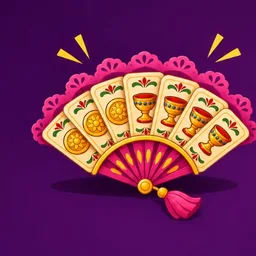
How to Play Chinchón
Chinchón rules for 2 to 4 players: the Spanish deck, the deal of seven, sets and runs, cutting with 5 or less, the minus ten, chinchón itself and elimination over 100.
What is Chinchón?
Chinchón is the seven-card rummy of Spain, Argentina and Uruguay (where many call it conga), a close cousin of Gin Rummy. Each player holds seven cards, draws one and throws one each turn, and tries to fit the hand into sets and runs.
When the cards you cannot meld add up to 5 or less, you may cut (cortar): you put a card face down and everyone shows their hand. The others lay off what they can on your melds and score whatever is left loose. Score too much and you are out; the last player under the limit wins.
Seven cards in a row in one suit is chinchón, the hand the game is named after: it wins the whole game on the spot.
Also on bs.fyi: Gin RummyEscobaChinchón en español
Chinchón rules at a glance
- Players
- 2 to 4, each for himself
- Cards
- The 40-card Spanish deck (no 8s, 9s or jokers), or 50 cards: the 48 and 2 jokers (comodines)
- Deal
- 7 cards each, one card turned up to start the discard pile
- Your turn
- Draw from the stock or take the top discard, then discard
- Melds
- Sets of 3–4 of a rank; runs of 3+ in one suit (with 40 cards, 7 then sota)
- Cutting
- Put a card face down with 5 points or less left loose, from your second turn
- Card values
- 40 cards: 1–7, sota 8, caballo 9, rey 10. 50 cards: face value, sota 10, caballo 11, rey 12; a joker in hand 20
- Minus ten
- Cut with all seven cards melded: −10
- Chinchón
- Seven in a row in one suit, no joker: you win the game
- Elimination
- Over 100 points you are out (short game: over 50)
- Winner
- The last player left in
How to play Chinchón, step by step
- 1
Deal seven
Each player gets seven cards, one at a time. The next card goes face up to start the discard pile, and the player after the dealer starts.
- 2
Draw
Take the top card of the stock (face down) or the top card of the discard pile (everyone sees which). You may not throw back the card you just took from the pile.
- 3
Meld in your hand
Sort your cards into sets (three or four of the same rank) and runs (three or more in a row in one suit). Melds stay in your hand until someone cuts.
- 4
Discard or cut
End the turn with a discard face up. Or, if the seven cards you keep hold 5 points or less outside your melds, put the eighth face down: you cut.
- 5
Show and lay off
Everyone shows their melds. The others add whatever they can to the cutter’s melds, and then count their loose cards.
- 6
Score and go out
Loose cards go on your total. The cutter scores their own loose points, or −10 with everything melded. Over 100 you are out; the last one in wins.
The Spanish deck and its order
Chinchón is played with the Spanish deck: oros (coins), copas (cups), espadas (swords) and bastos (clubs), each with the ace (as), 2 to 7, and the three figures: sota, caballo and rey. That is the 40-card deck, the most common in Spain and our default.
In Argentina and Uruguay many play with 50 cards: the 48-card deck, which also has the 8s and 9s, plus two jokers (comodines). You pick the deck when you start a game.
Cards run in this order: as, 2, 3 … 7, (8, 9,) sota, caballo, rey. With 40 cards there is no gap between the 7 and the sota, so 6-7-sota is a run. The ace is low only: rey-as-2 is not a run.
Sets and runs
A set is three or four cards of the same rank, each in a different suit: three sotas, or four 5s.
A run (escalera) is three or more cards in a row in one suit, such as 3-4-5 of oros or 7-sota-caballo of bastos.
With the 50-card deck a joker stands for any card in a set or a run. Every meld still needs two real cards, and a set holds four cards at most.
Cutting
After you draw you hold eight cards. To cut, you put one of them face down; of the seven you keep, the cards outside your melds must add up to 5 points or less. A single loose 5, a 2 and a 3, or nothing at all.
Nobody may cut in the first round of a hand: every player has a turn first. Cutting is never compulsory, and you may wait for a better hand.
Once you cut, everyone shows their melds. The other players, starting after you, may lay off their loose cards on your melds: a fourth card on your set, or cards at either end of your run. They cannot lay off on each other’s melds.
Scoring and the minus ten
Each player adds the value of their loose cards to their total: with 40 cards the ace counts 1, the 2–7 their number, the sota 8, the caballo 9 and the rey 10. With 50 cards every card counts its number (the sota 10, the caballo 11, the rey 12) and a joker left loose 20.
The cutter scores their own loose cards too. If all seven of their cards are melded (for example a run of four and a set of three), they score −10, the famous menos diez.
If the stock runs out, the discard pile (all but its top card) is shuffled to make a new one. If that has happened twice already, the hand ends with no cut and everyone scores their loose cards.
Chinchón
Seven cards in a row in one suit, without a joker, is chinchón. Cut with it and you win the whole game at once, whatever the scores.
A seven-card run with a joker in it is not a chinchón: it is an ordinary cut with everything melded, worth −10.
Elimination and the end of the game
A player whose total goes over 100 is out (exactly 100 stays in). The others play on, and the last player left wins. In the short game the limit is 50. With two players the same limits apply.
On bs.fyi, when you play against the computer and you are out, the game ends there: the lowest total still in wins.
Variants we leave out
Re-entry (reenganche): in many groups a player who is out may buy back in with the score of the highest player still in. We do not offer it yet.
Some tables cut only with 3 or less, or with no loose card at all; some forbid cutting when it would take you over 100; some score chinchón as −50 or −100 instead of winning the game, or give −25 or −50 for a chinchón with a joker. Others play with only one joker, or play with the as de oros as the joker.
Chinchón strategy tips
- •Throw high cards early A loose rey costs 10. Early in a hand, keep low cards and pairs and let the figures go unless they make a meld.
- •Watch what others take Every card taken from the pile is public. Do not throw a card that fits next to what the next player picked up.
- •Cut while the others are high A quick cut hurts most when the others still hold big loose cards. Waiting for −10 only pays early in the hand.
- •Keep runs open A run can grow at both ends, a set only to four. Six in a row in one suit is one card from chinchón: worth a few turns if the card is still unseen.
- •Mind the lay-offs When you cut, the others may lay off on your melds. A run that is easy to extend helps them; a full set of four gives them nothing.
- •Play the scoreboard Near the limit, cut early and take small risks; a player far ahead can afford to wait for a better hand.
Keep playing
Start on Easy. Win a game to move up, and come back for the daily deal.
Bot levels
- EasyOpen
- MediumOpen
- 🔒 HardWin on Medium to unlock
Daily deal: everyone plays the same cards today
Chinchón questions
How many cards does Chinchón use?
The 40-card Spanish deck in Spain (no 8s, 9s or jokers), or 50 cards (the 48-card deck and two jokers) as many play in Argentina and Uruguay. You can choose either on bs.fyi.
When can you cut in Chinchón?
After drawing, when the seven cards you keep have 5 points or less outside your melds. You put the eighth card face down. Nobody cuts in the first round of a hand.
What is chinchón?
Seven cards in a row in one suit with no joker. Cutting with it wins the whole game at once.
What is the minus ten?
Cutting with all seven cards melded: you score −10 for the hand instead of zero.
Do 7 and sota make a run?
Yes, with the 40-card deck: there are no 8s or 9s, so the sota comes right after the 7. With the 50-card deck the 8 and 9 sit between them.
When are you out in Chinchón?
When your total goes over 100 (over 50 in the short game). The last player left wins.
Can I play Chinchón for free?
Yes. Play in your browser against the computer at three levels, or open a private table for family and friends, with no download and no sign-up.
Ready to play Chinchón?
Play two to four against the computer at three levels, or with friends at a private table, with the 40- or 50-card Spanish deck.